
Making Waves In Science
Family trips make great memories. We love to visit the national parks. At one park with a lake, my daughter, Evelynn, was standing at the edge throwing rocks into the water. My husband, Aaron, saw a great big mosquito land on her leg. He didn’t want her to have an itchy bite, so he ran up to swat the mosquito. He overestimated the amount of force it would take to squash the bug and instead, the force his motion transferred into her leg, knocking her off balance, and she fell forward right into the freezing cold water. Or at least that’s what he claims happened. None of the rest of us saw the mosquito. We still laugh about it. Family outings are not only a great source of memories, they are also a chance to learn. The experience of throwing rocks into water can prepare you to understand one of the basic principles of science, the motion we call a wave.
Elementary schools spend so much time learning about reading and writing that there isn’t always enough time for science. At home, science is one of the most entertaining things to learn with your child. Waves are important in science and technology. When my oldest son Jackson was in elementary school, his teacher asked what his parents did, and he said, “Oh, they are both scientists.” That was partially true. My husband is a doctor. He studies science but probably wouldn’t call himself a scientist, and I was a stay at home mom back then, but I am always experimenting with things. So, while I might think and act like an amateur scientist, nobody pays me for my experiments, or my podcast, for that matter.
I am very conscientious about bedtime stories and counting with young children. But in my house science is either a random conversation or a special planned activity. In fact, I’m going to be honest with you and tell you that doing science at home won’t really make or break your child’s success in school. However, it creates a sense of excitement about the world around us that is so positive. It is also a wonderful way to teach critical thinking and problem-solving skills.
Asking Questions
There is an easy way to help your kid develop scientific thinking. Most of them are born curious, so it’s pretty simple to turn a random question into a scientific exploration. Sometimes we are so exhausted with all the work involved with parenting that our kids’ curiosity can annoy us. I am so grateful to Alexa because she is so patient about answering Yogi’s random questions. But parents can turn a why question into a learning conversation. Often, I don’t know the answer to my child’s questions. But a scientist is not a know-it-all. A true scientist can say, “I don’t know,” but instead of being ok with “I don’t know,” they try to figure out the answer. This is a thinking habit that, unfortunately, school discourages in children. The teacher doesn’t have time to go down random rabbit holes when there are 24 rabbits in the classroom.
Forming a Hypothesis
When my children ask questions I don’t know the answer to, I respond by saying. “Hmmm, that’s a good question.” If I add “what do you think?” They are going to say “I don’t know. That is why I asked you.” So instead I said, “Let’s make some guesses.” Then we take turns making guesses. Some of my kids would engage their imaginations and come up with magical or fantastical stories, which was pretty fun. Science can turn into creative writing sometimes. I always try to teach scientific vocabulary, so I say, “That is a really interesting hypothesis.” They will ask what the word hypothesis is, and you can say it’s a scientific guess.
Testing a Hypothesis
With preschool-age children, encouraging questions and forming hypotheses is a great start to developing critical thinking skills. As they get into elementary school, you can move on to the next skill in scientific thinking, which is developing a way to test a hypothesis. You could say, “Hmm, that is a good hypothesis. I wonder how we could test that?” Thinking about ways to test guesses is the basis of scientific inquiry. Some of my children’s best at-home science lessons have come from creating ways to test their questions. For example, seven-year-old Evelynn wanted to know how fast her kittens would grow up. We ended up weighing and measuring those kittens every day and making a graph. She learned exactly how fast those kittens grew and it taught her some great math skills. Another time she wanted to know how many worms lived in our yard, and we ended up scooping out dirt from different parts of the yard and counting how many worms each scoop had. We found a lot in the vegetable garden, but practically none in the compacted dirt by the road. Then we decided we were too lazy to do the complicated math and figure out how many worms were in our yard, but it was still fun and we learned a lot about soil. If you are a very busy family, you don’t actually have to test all of their ideas, but if they are curious enough, they might just do their own experiment. How far you take it will depend on the time you have to play scientist with them, but it is perfectly fine to just leave it conversational. It still helps them develop critical thinking skills.
Not all of my kids have been curious about scientific ideas, so sometimes I plan science adventures for their days off. Yogi knows that if he stays home sick from school, we are going to do “homeschool science.” This usually involves watching YouTube videos and doing a simple activity. Don’t get overwhelmed about adding science to your daily list of things to worry about, but it never hurts to get ideas for activities to do on a rainy day or Christmas Vacation.
Wave Motion
When I told my son in medical school that my next episode would be about waves, he said, “I thought you were doing first grade stuff.” But waves are a first-grade standard and they are something you deal with every day, even if you are not a surfer. You can see things because light waves travel from the sun or from a lightbulb and bounce off objects before they reach your eyes. You can hear because sound waves travel from vibrating objects through the air to your ear. You probably cook with microwaves, use Wifi, or listen to the radio. These are all examples of energy traveling in waves.
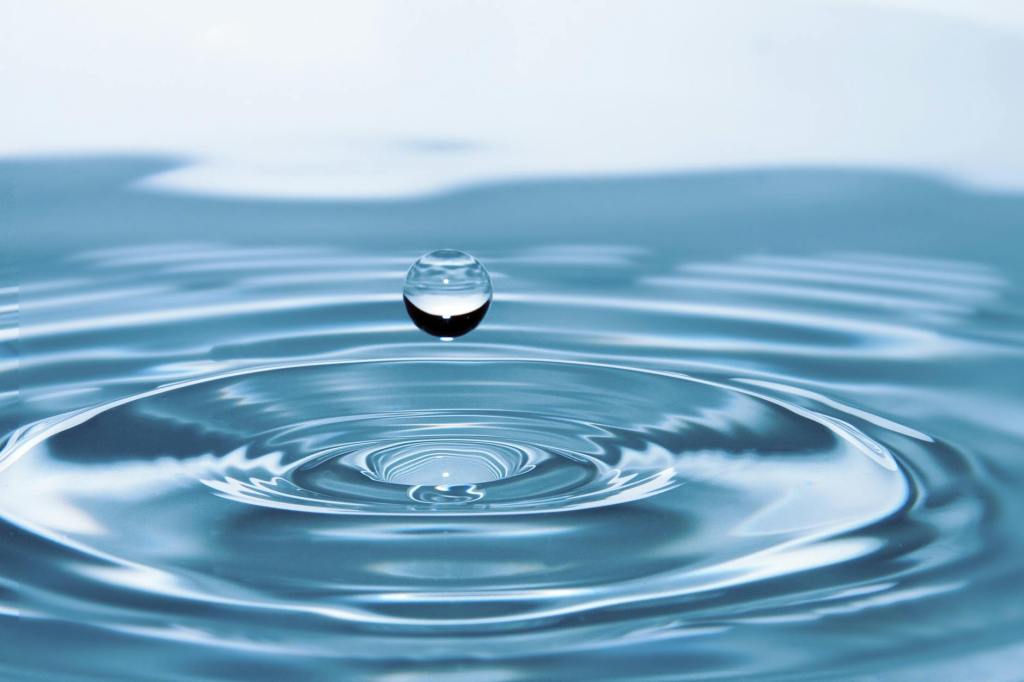
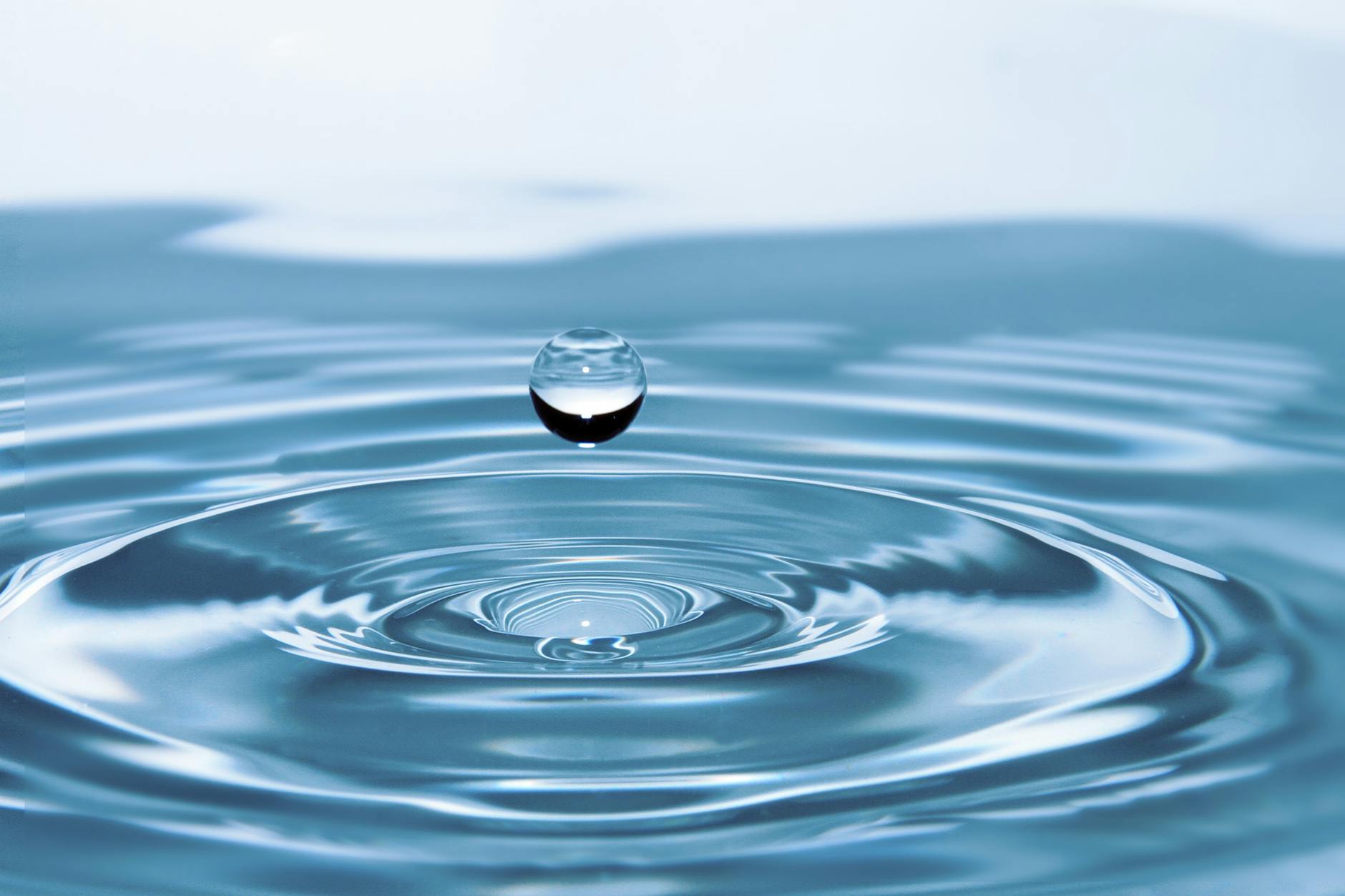
I like to introduce wave science by playing with water. Kids love to throw rocks in puddles, ponds or lakes. Throwing rocks into water is something fun to do with your family on the weekend, and it is free. Even iPad lovers still love to try skipping rocks. If you live by the ocean, you can observe waves at the beach. But instead of just throwing or skipping rocks, you can get your child into scientific observation mode. You can say, “Look how the water moves after you throw a rock in. What do you notice?” They will probably notice how the ripples spread outwards from where the rock landed. If they are really observant, they might notice how the rings of ripples get farther apart as they move outward. They might even see a little drop of water burst out of the center of the rings of ripples. Your child might come up with follow-up experiments, but if they don’t, you could suggest some. “What happens to the waves if you throw two rocks at the same time?” Your kids can also make waves in the bathtub.
We got in the habit of putting less water in Evelynn’s bath because she used to like to slide down the side of the tub into the water to watch it make waves. She noticed that if she slid from higher up it made a big wave, and closer down it made a “baby one.” You will need a mop or a lot of towels for the bathtub wave making, but you can make a small wave simulator by filling an empty water bottle with half water and half vegetable oil.
If you rock the bottle gently back and forth, you will make waves that you can observe from the top, bottom or from the side of the bottle. An interesting experiment you could do in your bottled ocean or in your bathtub is to put a floating object in it and see if the waves move the object from one end of your container to the other or if they just bob up and down. Here’s a hint, the object will mostly move up and down because the water isn’t going back and forth, only the energy in the waves is. There is a visual explanation of why this happens on pbslearning media.org.
I also like to use digital wave simulators in my classroom and I have found that kids love them because they can easily change things on the screen and do little digital experiments. My favorite simulator is the University of Colorado’s waves intro on their PHET simulator It is a little interactive digital simulation of a wave container (in the water version it is a sink with a faucet). If you press the button on the faucet, it drips into the sink. Kids can observe the ripples radiating outward from the top of the sink, or they can switch to the side view and see how the water drip makes the surface of the water move up and down in waves. They can also play around with how fast the drips fall, which changes the wave frequency, or how big the falling drips are, which will change the amplitude. If you have just tuned out because I talked too much science, that is ok. You don’t actually have to teach this to your kid, you can learn alongside them. When I have students use simulators, I usually just pull up the simulator for them and tell them to play around with the buttons for a while. Most will only be interested for a minute or two, some will want to play with it for a really long time. The benefit of looking at this at home is you can gauge how interested they are and stop when they are bored, or let them play with it as long as they want to. In a classroom, you usually have half the kids bored in thirty seconds and the other half disappointed when you make them move on after fifteen minutes.
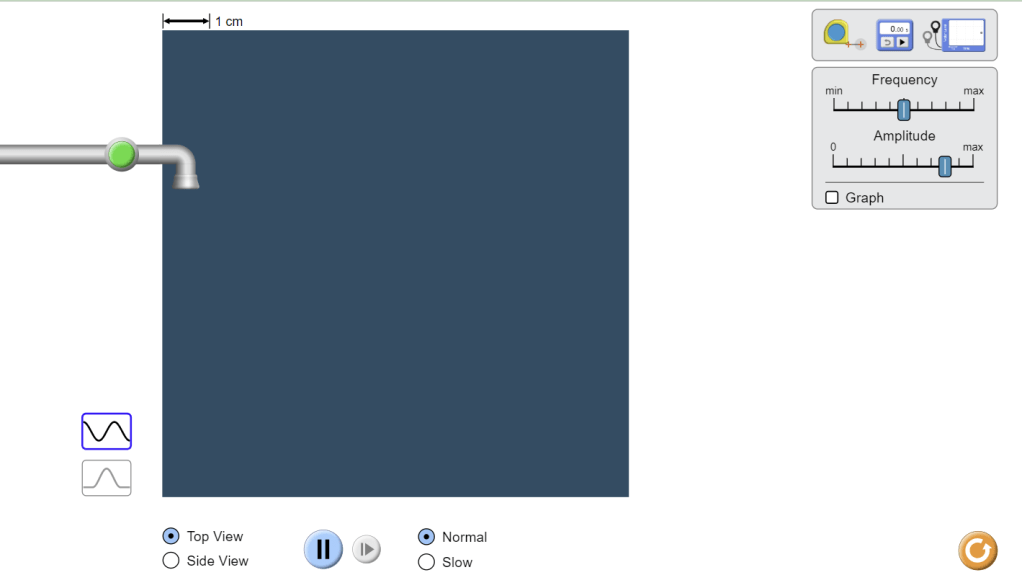
“Waves Intro.” PhET, https://phet.colorado.edu/sims/html/waves-intro/latest/waves-intro_en.html.
After I let my kids play with the simulator for a minute, I ask questions like
- “What did you notice happening when you moved this slider, this one that changed the frequency?”
- “How does the wave look different from the top versus from the side?”
Make sure all the observations come from them and don’t tell them anything. You just want them to start noticing things and experimenting. You don’t have to explain the science, especially if you don’t understand it yourself.. The purpose is to get them noticing, wondering, and testing out what happens when you do different things.
Don’t be intimidated if science wasn’t your best subject in school. I had a hard time in school science. When I didn’t understand something, it was hard for me to memorize it. As a teacher and a parent, I am finding out that this “learning obstacle” would have actually made me an excellent scientist. One day, after teaching a lesson about waves, I was playing with the simulator myself and I started coming up with all kinds of questions. When I googled those questions, I found that in the past ten years, scientists with these same questions have made some outstanding new discoveries. I wasn’t stupid because I was slow at memorizing science, I actually had an aptitude for questioning. While schools are great at teaching kids to memorize, they aren’t very good at fostering creativity and critical thinking. With the rise of the internet and AI, memorizing facts is becoming less and less valuable, and critical thinking and problem-solving skills are getting more and more valuable. Luckily, it is pretty easy to do and say small things at home that will help your child learn to think like a scientist. You might even find these activities sparking your own curiosity, but right now it’s time to put down your phone and go play with your kid.
Resources
Calandrelli, Emily. “How to Make an Ocean in a Bottle | Sophie’s World.” YouTube, 1 March 2019, https://www.youtube.com/watch?v=AAfr031u_Zw. Accessed 2 February 2026.
Iris Earthquake Science. “Ripples On A Pond.” YouTube, https://youtu.be/T9QwiBFN9gI?si=wtOA4Mwstgfo9XOw.
“Waves Intro.” PhET, https://phet.colorado.edu/sims/html/waves-intro/latest/waves-intro_en.html. Accessed 2 February 2026.
“Waves: Wavelength & Amplitude Video For Kids | 3rd, 4th & 5th Grade.” Generation Genius, https://www.generationgenius.com/videolessons/wave-properties-video-for-kids/. Accessed 2 February 2026.
 Public School Success
Leave a comment